

Two Currencies, Completely Different Rules
Every sweepstakes casino in the US operates on a dual-currency system, and understanding the difference between those two currencies is the single most important thing a new player can learn. Get this wrong, and you’ll waste time accumulating coins that have no cashout value. Get it right, and you’ll know exactly which part of every daily bonus, purchase, and promotion actually matters.
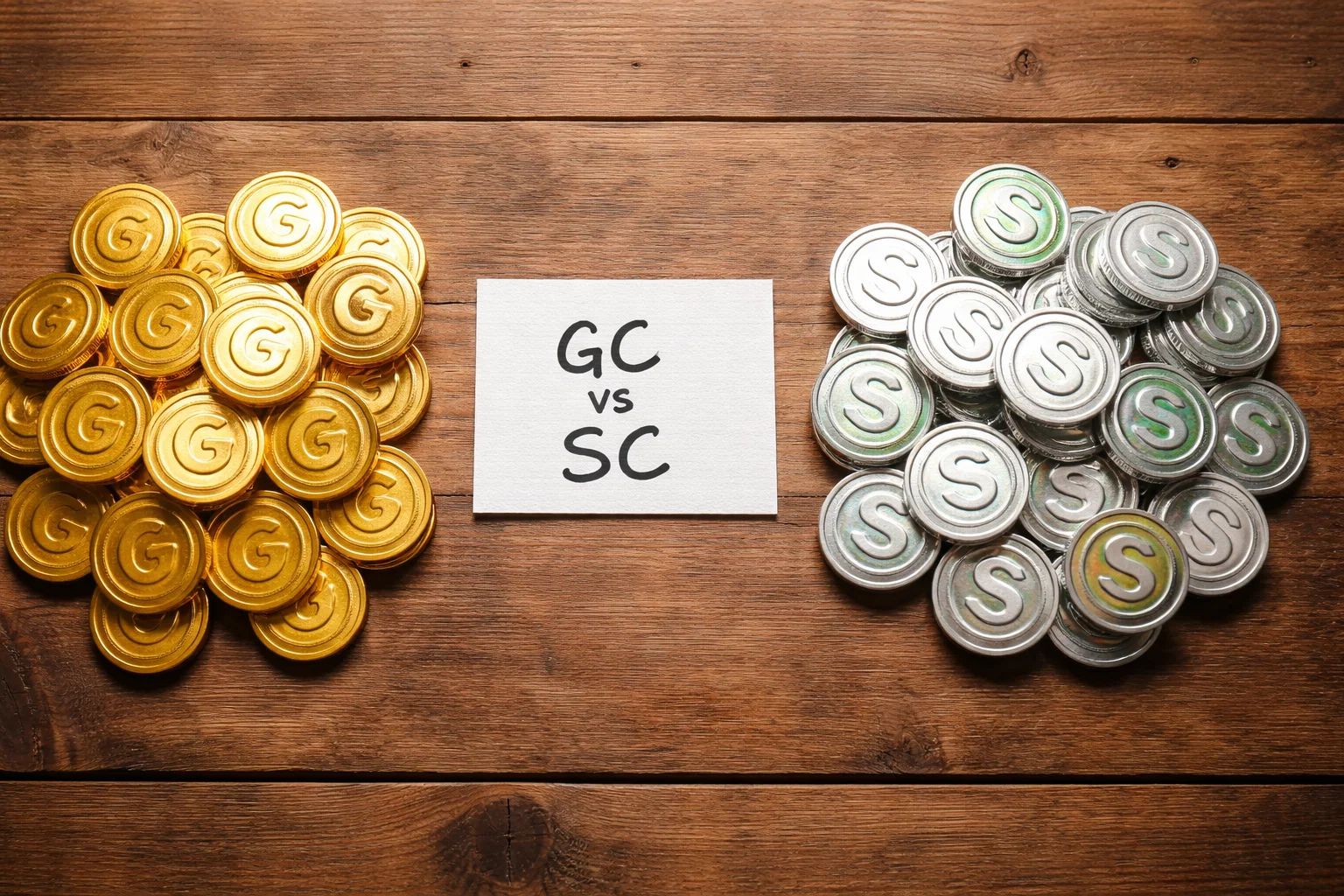
Gold Coins and Sweeps Coins look similar on screen. They sit side by side in your account balance. You use both to play the same games. But they are fundamentally different in what they represent and what you can do with them. SC is real value — GC is practice. That distinction drives every decision a smart player makes, from which bonuses to prioritize to which games to play during playthrough.
This guide breaks down both currencies from the ground up: what each one is, how you earn it, what you can do with it, and why the whole system is structured this way in the first place. If you’re new to sweepstakes casinos, this is where to start.
What the sweeps coins convert to is in SC value.
Gold Coins: The Play Currency That Can’t Be Cashed Out
Gold Coins are the virtual play currency at sweepstakes casinos. You can buy them, earn them through bonuses, and use them to play every game on the platform. What you cannot do is redeem them for cash, gift cards, or anything with real-world monetary value. GC are a dead end in financial terms — they exist to give you playtime and nothing more.
When you see a Gold Coin package for sale — “Buy 1,000,000 GC for $9.99” — you’re purchasing exactly what it says: virtual coins for entertainment purposes. The legal significance of this is enormous. Because Gold Coins have no redemption pathway, buying them doesn’t constitute gambling under US law. You’re purchasing a digital product for entertainment, similar to buying extra lives in a mobile game.
Gold Coins are distributed generously, and that generosity is deliberate. Platforms award massive GC amounts in daily bonuses, welcome packages, and promotions because the coins cost the operator essentially nothing to create. A daily bonus of 10,000 GC sounds impressive, but those 10,000 GC represent zero dollars of liability on the operator’s balance sheet. They’ll never need to pay them out.
For players, GC serve two practical purposes. First, they let you explore the platform’s game library without risking SC. You can test a new slot’s volatility, try out table games, or experiment with different bet sizes using GC — and if you lose them all, you’ve lost nothing of economic value. Second, GC extend your playtime between SC accumulation periods. If you’ve claimed your daily SC bonus and are waiting for tomorrow’s, GC let you keep playing for entertainment without burning through your redeemable currency.
The mistake new players make is treating GC and SC as interchangeable. They’re not. Winning 50,000 GC on a slot feels exciting until you realize those coins can’t leave the platform. Keep your GC in the entertainment category mentally, and reserve your strategic thinking for SC.
Sweeps Coins: The Redeemable Currency
Sweeps Coins are the currency that makes sweepstakes casinos different from standard social casinos. SC can be redeemed for real cash prizes — typically at a rate of 1 SC = $1 USD — after meeting the platform’s playthrough requirements. This is the currency with actual economic significance, and it’s the one that generates real revenue for both operators and players.
The distinction between sweepstakes casinos and pure social casinos is stark when you look at the numbers. The traditional social casino market — platforms where virtual currency has no redemption value at all — generated approximately $7.1 billion in gross revenue in 2024, according to a KPMG industry primer citing Eilers & Krejcik Gaming data. Sweepstakes casinos, which add the SC redemption layer on top of the social casino model, generated over $10.6 billion in the same period. The difference — roughly $3.5 billion — represents the economic gravity that the redeemable currency introduces.
SC are earned in several ways: bundled as a free bonus with GC purchases, awarded through daily login bonuses, distributed via social media giveaways, and obtained through AMOE mail-in requests. Crucially, you never directly buy SC. The legal framework requires that SC are always free — they’re either included as a promotional bonus with a GC purchase or earned through no-purchase channels. This semantic distinction is the foundation of the sweepstakes model.
Before you can redeem SC for cash, you must play through them. Most platforms require a 1x playthrough — meaning you need to wager the SC amount at least once on eligible games. During that playthrough, the house edge will reduce your SC balance. If you wager 10 SC on a slot with 95% RTP, you’ll statistically end up with about 9.5 SC. The surviving balance is what you can redeem.
Minimum redemption thresholds apply. Most platforms require a minimum of 50 to 100 SC before you can initiate a cashout. For free players accumulating SC solely through daily bonuses, reaching that threshold takes weeks of consistent claiming — another reason to think of SC as a long-term accumulation game rather than a quick payout opportunity.
How Daily Bonuses Distribute GC and SC Differently
Every daily bonus at a sweepstakes casino includes both currencies, but the ratio between GC and SC tells you a lot about the platform’s priorities and how it values free players.
A typical daily bonus might offer 10,000 GC and 0.3 SC. The GC number looks large; the SC number looks small. But in economic terms, the 0.3 SC is worth approximately $0.30 while the 10,000 GC is worth exactly $0.00. The platform spends real money — in the form of future redemption liability — only on the SC portion. Everything else is cosmetic.
Some platforms lean heavily on the GC side, offering enormous Gold Coin bonuses with minimal SC. This creates an illusion of generosity. A daily bonus of 50,000 GC and 0.1 SC sounds bigger than one offering 5,000 GC and 0.5 SC, but the latter is five times more valuable in terms of redeemable currency. New players who don’t understand the distinction gravitate toward the higher GC numbers and miss the platforms that deliver better SC value.
Streak-based systems add another dimension. Crown Coins, for example, escalates both GC and SC amounts over its seven-day cycle, but the SC escalation is typically proportionally larger than the GC increase. Day-one GC might be double the day-one level by day seven, while day-seven SC might be triple or quadruple the day-one amount. The operator is investing more in SC retention incentives as the streak progresses, which signals that they understand what motivates players to keep coming back.
When evaluating any daily bonus, train yourself to look at the SC number first and the GC number second. The SC amount determines the real economic value of your daily claim. The GC amount determines how long you can play for fun. Both have utility, but only one has a pathway to your bank account. SC is real value — GC is practice, and building that mental framework early saves new players from chasing the wrong numbers.
Why the Dual-Currency Model Exists (Legal Angle)
The dual-currency system isn’t a design choice made for player convenience — it’s a legal architecture. Every element of how GC and SC interact is built to satisfy the three-part test that separates a sweepstakes from gambling under US law: prize, chance, and consideration. Remove any one of those three elements, and the activity isn’t legally classified as gambling. The dual-currency model targets the “consideration” element.
In a traditional casino, you bet real money — that’s consideration. In a sweepstakes casino, you buy Gold Coins (a non-redeemable virtual product), and receive Sweeps Coins as a free bonus. The legal argument is that you’re not paying for the chance to win SC prizes; you’re buying GC, and the SC are a promotional giveaway. AMOE — the alternative method of entry by mail — reinforces this by proving that SC can be obtained without any purchase at all.
This framework allows sweepstakes casinos to operate in most US states without holding a gambling license. The scale of what this enables is enormous — KPMG data shows the sweepstakes sector surpassed $10.6 billion in gross revenue during 2024. That entire figure exists because the dual-currency model creates enough legal separation from gambling to sidestep most state gaming regulations, though that separation is shrinking as California, New York, and Montana pass specific bans targeting the sweepstakes model.
For players, the legal dimension has practical implications. The dual-currency structure means operators can adjust GC amounts freely without regulatory scrutiny, but changes to SC distribution, playthrough requirements, or redemption terms may attract attention from state attorneys general. It also means that if a state bans sweepstakes casinos, both currencies become inaccessible — you can’t use GC or SC on a platform that’s been blocked in your jurisdiction.
Understanding the legal reason behind the two currencies doesn’t change how you play, but it does change how you evaluate the platforms themselves. A casino that respects the boundaries of the sweepstakes model — maintaining genuine AMOE access, keeping SC distribution transparent, and complying with state restrictions — is more likely to remain operational long-term than one that pushes the legal limits. For a player accumulating SC over months through daily bonuses, platform longevity matters as much as daily bonus amounts.
The wider context is set out in our daily bonus comparison.
This content is for informational purposes only. Sweepstakes casino availability varies by state. Always verify that a platform operates legally in your jurisdiction before registering. Play responsibly.