
From Free SC to Real Cash — What Nobody Tells You
You’ve been logging in every day. You’ve claimed your sweepstakes casino daily bonus, maintained your streak, spun the wheel, maybe even followed the social media accounts. Your SC balance looks healthy. Now comes the part that most daily bonus guides conveniently skip: actually turning those Sweeps Coins into real money in your bank account. Claim, play through, cash out — that’s the sequence, and the last step is where most of the friction lives.
The redemption process at sweepstakes casinos is not a simple withdrawal button. It involves playthrough verification, minimum balance thresholds, identity verification (KYC), method selection, processing queues, and — depending on the platform and method — waiting periods that can stretch from hours to weeks. None of this is hidden, exactly, but it’s buried deep enough in terms of service that many players encounter it for the first time only when they try to cash out. By then, they’ve already accumulated SC without understanding the rules that govern its conversion to dollars.
This guide covers the full redemption pipeline from playthrough completion to funds received, based on the mechanics of major US sweepstakes platforms as of early 2026. The goal is practical: what you need to do, in what order, how long it takes, and where things most commonly go wrong. If you’ve earned SC from daily bonuses and want to convert it to cash, this is the process — no shortcuts, no myths, just the actual steps.
Which payout method to pick is in Skrill against bank transfer.
Playthrough 101: The 1x Rule and Its Exceptions
Before you can redeem a single Sweeps Coin, you must play through it. The playthrough requirement exists because sweepstakes casinos are, legally, promotional sweepstakes — not gambling platforms. The SC you receive from a daily bonus is an entry into a sweepstakes promotion, and the “play” element is part of what distinguishes the model from a straight cash giveaway. As attorney Jonathan Michaels of Michaels Strategies has argued, sweepstakes operators have been “mischaracterized” by critics, and the play-through-to-redeem structure is one of the legal mechanisms that operators cite as evidence that their model differs fundamentally from traditional gambling. The sweepstakes framework depends on this distinction.
The standard playthrough requirement at most major platforms is 1×, meaning you must wager the SC amount once on eligible games before it becomes redeemable. If you receive 1 SC from a daily login bonus, you place 1 SC total in bets across slots or other qualifying games. Whatever your balance shows after those bets resolve — factoring in wins and losses — becomes your redeemable amount. At the industry-standard 1× playthrough, the process is quick: a few minutes of slot play typically satisfies the requirement.
The 1× standard is not universal, though. Some platforms apply different playthrough rates to different bonus types. Daily login bonuses almost always carry 1× playthrough, but SC earned from promotional codes, social media giveaways, or special events may have 2× or 3× requirements. Always check the specific terms attached to each SC credit — platforms usually display the playthrough status in your account dashboard, showing which SC is “pending” (not yet played through) and which is “redeemable.”
The operator payout rate — the industry-wide figure of 68–72% according to RG.org — provides important context. At a 1× playthrough with a 96% game-level RTP, approximately 96% of your SC survives the playthrough. But the 68–72% payout rate across the industry reflects the aggregate behavior of all players, including those who continue wagering beyond the minimum playthrough. The lesson: complete the playthrough requirement, then stop playing with that SC and proceed to redemption. Every additional wager beyond the minimum erodes your balance toward the lower system-wide payout rate.
Game contribution rates add another layer of complexity. Slots universally contribute 100% toward playthrough — every dollar wagered on slots counts fully. Table games typically contribute at reduced rates: 10–20% is common, meaning a $1 blackjack bet might count as $0.10–$0.20 toward your playthrough progress. Some platforms exclude certain game categories entirely. For daily bonus SC, the optimal playthrough strategy is straightforward: use the highest-RTP slots available with 100% contribution, complete the 1× requirement as quickly as possible, and move immediately to the redemption step.
Minimum Thresholds: How Much SC You Need to Cash Out
Even after playthrough is complete, you can’t redeem until your redeemable SC balance meets the platform’s minimum threshold. This minimum varies by operator and, in some cases, by redemption method.
Most major sweepstakes casinos set the minimum redemption threshold between 50 SC and 100 SC ($50–$100 equivalent). Chumba Casino’s minimum is 100 SC for bank transfer and lower for Skrill. WOW Vegas sets its minimum at 50 SC. High 5 Casino requires 50 SC for standard redemption. Stake.us has varying minimums depending on the currency type (SC vs Stake Cash) and the withdrawal method. Newer platforms sometimes offer lower minimums — 10 SC or 25 SC — as an onboarding incentive, though these introductory thresholds may increase after the first redemption.
The minimum threshold directly affects the timeline for daily bonus players. At a platform with a 100 SC minimum and a 1 SC daily bonus, you need 100 consecutive claimed days — over three months — before your first redemption is possible. At a 50 SC minimum, the timeline shrinks to roughly 50 days. Players running multi-casino rotations spread their SC across multiple accounts, which means each individual account takes longer to reach its redemption threshold.
The scale of the operators behind these thresholds is worth noting. VGW, parent of Chumba Casino, operates at a revenue level of approximately A$6.1 billion annually, processing billions in redemptions. The infrastructure to handle payouts at that scale exists — the minimum thresholds aren’t about payment processing limitations, they’re about reducing the administrative cost of small transactions and ensuring that only engaged players enter the payout pipeline.
Strategic advice: choose your primary bonus-claiming platforms partly based on minimum thresholds. If your goal is to redeem frequently, prioritize platforms with lower minimums. If you’re comfortable with longer accumulation cycles, higher-minimum platforms with better daily bonus rates may deliver more value per redemption. And keep track of your redeemable balance across all platforms — knowing exactly when each account will cross its threshold helps you time your playthrough sessions and avoid wasting SC on games when you’re nowhere near the redemption minimum.
Redemption Methods Ranked: Speed, Fees, Limits
Once your SC balance is played through and above the minimum threshold, you select a redemption method. The available options vary by platform, but the three most common are Skrill (an e-wallet), direct bank transfer (ACH), and — at a growing number of platforms — cryptocurrency. Each has distinct trade-offs in speed, fees, and limits.
Skrill. The fastest redemption method at most sweepstakes casinos. Processing typically takes 1–3 business days after approval, and some platforms process Skrill redemptions within 24 hours. Skrill acts as an intermediary wallet: the SC redemption deposits into your Skrill account, and you then transfer from Skrill to your bank or card. The extra step adds time but provides a layer of separation between the sweepstakes casino and your bank. Skrill charges fees for certain transactions — withdrawals to bank accounts or currency conversions may incur percentage-based fees, so check Skrill’s current fee schedule before treating the redemption as a zero-cost transfer. Most platforms offer Skrill with the lowest minimum threshold, often 50 SC.
Bank transfer (ACH). Direct deposit to your US bank account. Processing is slower — typically 3–7 business days after approval, with some platforms taking up to 10 business days for first-time bank transfers. The advantage is simplicity: no intermediary account needed, and the funds arrive directly in your checking or savings account. The disadvantage is speed and sometimes higher minimum thresholds. Some platforms require 100 SC or more for bank transfers while allowing 50 SC for Skrill. ACH bank transfers are generally fee-free from the casino’s side, though your bank may apply incoming transfer fees depending on your account type.
Cryptocurrency. A handful of platforms — most notably Stake.us — offer Bitcoin, Ethereum, or other cryptocurrency redemptions. Processing can be the fastest option (sometimes under an hour once approved), and the minimum thresholds are sometimes lower than bank transfer. The trade-offs include exchange rate volatility between the SC dollar-equivalent value and the crypto’s market price at the time of redemption, plus the need for an existing crypto wallet. For players already in the crypto ecosystem, this can be the most efficient method. For everyone else, the learning curve and volatility make Skrill or bank transfer more practical.
Gift cards. Some platforms offer redemption in the form of retail gift cards — Amazon, Visa prepaid, or similar. The value is typically equivalent to the SC amount, and processing is fast (often within 24 hours via email delivery). The limitation is that gift cards aren’t fungible cash — you can’t pay rent with an Amazon gift card. For players who would spend the redeemed value on everyday purchases anyway, gift cards can be the quickest path from SC to spendable value. For those who want cash in their bank account, gift cards are a secondary option.
KYC Verification: Documents, Delays, and Denials
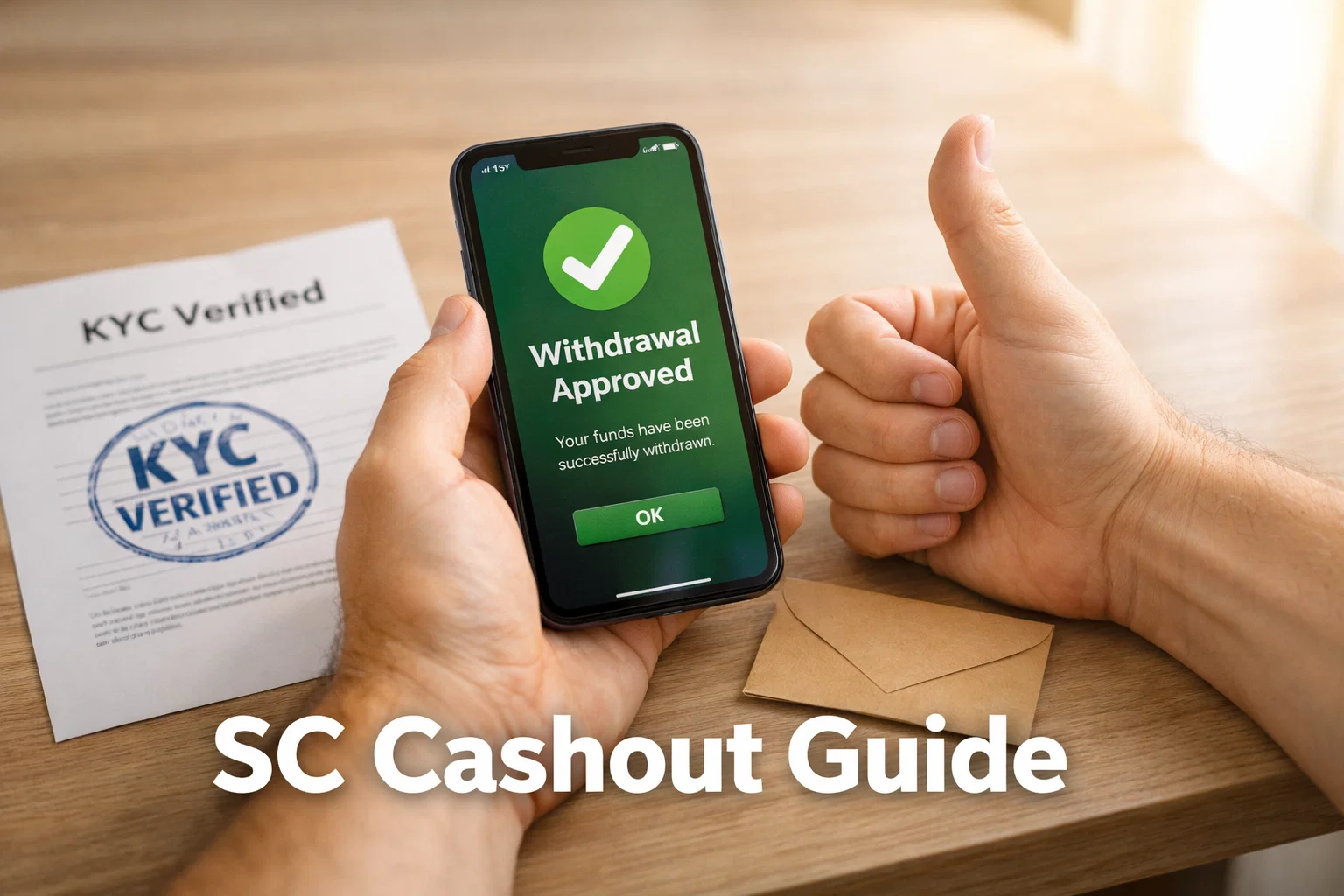
KYC — Know Your Customer — verification is the step that trips up more first-time redeemers than any other. It’s required by law and by the platform’s own compliance standards, and it must be completed before your first redemption processes. Some platforms allow you to complete KYC at registration, but most delay it until you initiate your first withdrawal. Either way, the documents and process are similar across the industry.
Standard documents required: A government-issued photo ID (driver’s license, passport, or state ID), proof of address (utility bill, bank statement, or government correspondence dated within 90 days), and — at some platforms — the last four digits of your Social Security Number. The photo ID must match the name on your account exactly. The address on your proof of address must match the address registered on your account. Discrepancies — even minor ones like abbreviation differences or a middle name on one document but not the other — can trigger delays.
Document submission process: Most platforms use an in-app or web-based upload interface. You photograph or scan each document and upload it directly. Image quality matters: blurry photos, cut-off edges, or glare on the ID face are the most common reasons for initial rejection. Use a flat surface, good lighting, and photograph the entire document including all four corners. Some platforms have switched to video-based verification using third-party services like Jumio or Onfido, which guide you through a real-time photo capture of your ID and a selfie check.
Typical processing times: Automated verification systems can approve KYC in minutes if the documents are clear and the data matches. Manual review, triggered when automated checks flag discrepancies, takes 1–5 business days at most platforms. First-time verifications tend to be slower than subsequent ones — some platforms queue first-time KYC submissions for manual review by default, regardless of document quality. A small percentage of players experience extended delays of 7–14 days, typically due to document issues, address mismatches, or platform-specific backlogs during high-traffic periods.
Common reasons for KYC denial: Name mismatch between ID and account registration. Address on proof of address doesn’t match the account address. Document expired. Photo quality too low for data extraction. ID type not accepted (some platforms don’t accept foreign passports or certain state-issued IDs). Each denial generates a request for resubmission, adding days to the process. The preventative measure is straightforward: complete KYC before you need to redeem. Most platforms allow voluntary early verification, and doing it before your first redemption eliminates the risk of a delay when you’re actually ready to cash out.
Real Payout Timelines: Tested Across 8 Casinos
The gap between “request submitted” and “funds received” is the metric that matters most, and it varies more than operators’ official estimates suggest. Here’s what the actual redemption pipeline looks like across major platforms, based on community-reported experiences and publicly documented payout histories.
Chumba Casino: Typically 3–5 business days for Skrill, 5–10 business days for bank transfer. Chumba’s parent company, VGW, processed $4.3 billion in prize redemptions during its FY2024 — a volume that speaks to operational maturity but also means the payout queue handles thousands of requests daily. First-time redemptions with pending KYC review can push timelines to 10–14 business days. Subsequent redemptions with verified accounts are faster.
WOW Vegas: Generally faster processing — 1–3 business days for Skrill, 3–5 for bank transfer. WOW Vegas has invested in payout infrastructure as a competitive differentiator, and user reports consistently place it among the faster-paying platforms. The trade-off is a relatively strict KYC process that can cause first-time delays.
Crown Coins Casino: Processing times of 2–4 business days for e-wallet, 5–7 for bank. Crown Coins’ smaller user base compared to Chumba or WOW Vegas may contribute to faster queue processing, though the platform’s newer operational history means less long-term payout data is available.
High 5 Casino: Approximately 3–5 business days for most methods. High 5’s payout process is well-documented given its longer market presence, and major processing delays are relatively rare outside of first-time KYC situations.
Stake.us: Crypto redemptions process quickly — often within hours once approved. Bank and Skrill options take 3–7 business days. Stake.us’s payout reputation is mixed: the crypto pipeline is fast and reliable, but fiat methods have generated occasional complaints about extended review periods, particularly for larger redemption amounts.
Across all platforms, a consistent pattern emerges: the first redemption takes the longest (due to KYC), subsequent redemptions are significantly faster, and e-wallet/crypto methods outpace bank transfers. Plan accordingly: complete KYC early, make your first redemption small (to test the pipeline), and use the fastest available method once your account is verified.
Common Redemption Errors and How to Avoid Them
Redemption failures are frustrating but almost always preventable. The most common errors fall into a few predictable categories, and knowing them in advance saves days of support tickets and resubmissions.
Attempting to redeem SC that hasn’t completed playthrough. The most frequent mistake. Players see a high SC balance and assume it’s all redeemable, without checking how much has been played through versus how much is still pending. Every major platform displays a “redeemable balance” separately from the “total SC balance.” Always verify the redeemable figure, not the total, before initiating a withdrawal request.
KYC document issues. Name mismatches, expired IDs, and blurry uploads account for the majority of KYC rejections. The fix is preemptive: verify your documents before you need to redeem, and ensure your account registration name exactly matches your government ID.
Requesting redemption below the minimum threshold. Some players try to redeem amounts just below the minimum, either by miscounting their balance or not accounting for a recent wager that reduced their redeemable total between the time they checked and the time they submitted the request. The system will reject the request, but the error message isn’t always clear about the reason.
Bank account rejection. ACH transfers fail if the bank account name doesn’t match the casino account name, if the routing number is incorrect, or if the receiving bank flags the incoming transfer as suspicious. Some smaller banks and credit unions have compliance filters that block transactions from companies associated with gambling or sweepstakes. If your bank transfer fails, contact your bank first — the issue is often on the receiving end, not the sending platform.
Redeeming from a restricted state. If your state has enacted a ban since you last verified your account location, the platform may block your redemption attempt until you update your address or resolve the compliance issue. Players who relocated from an available state to a banned state face this scenario. The platform isn’t necessarily keeping your money — it’s navigating a legal restriction — but the resolution can take days of support interaction.
The overarching prevention strategy: treat redemption as a process you prepare for, not a button you press impulsively. Verify KYC early. Check redeemable balance before requesting. Confirm your bank accepts the transaction type. And keep a record of your redemption history — dates, amounts, methods, and processing times — to identify patterns and flag anomalies quickly.
Tax Implications of SC Redemptions
Sweepstakes casino winnings are taxable income in the United States. This is the part of the redemption process that most players either don’t know about or actively prefer to ignore, but the IRS position is unambiguous: prizes won through sweepstakes, including SC redeemed for cash, are reportable income.
The sweepstakes casino industry is not a backwater anymore — with gross revenue exceeding $10.6 billion in 2024 according to KPMG, the IRS has ample reason to pay attention to SC redemption flows. Whether the agency actively audits individual sweepstakes casino players is a separate question from whether the income is technically reportable. It is.
The reporting threshold matters. Sweepstakes prizes of $600 or more in a calendar year from a single platform typically trigger a 1099-MISC or W-2G form from the operator. Below that threshold, the income is still technically reportable on your tax return, but the platform isn’t required to generate a reporting form. If you’re running a multi-casino rotation and redeeming less than $600 per platform per year, you may not receive any tax documents — but the obligation to report the income remains, technically, yours.
The practical considerations: keep records of all your SC redemptions — dates, amounts, platforms, and methods. If you receive a 1099-MISC, report it on your tax return. If you don’t receive one but your total annual redemptions across all platforms exceed the reporting threshold, consult a tax professional about your obligations. Gambling losses can offset gambling winnings for tax purposes, but sweepstakes casino losses (SC lost during playthrough) may or may not qualify as deductible gambling losses depending on how the IRS classifies sweepstakes activity — an area of tax law that remains ambiguous. This article does not constitute tax advice; consult a qualified tax professional for guidance specific to your situation.
The wider context is set out in our daily bonus comparison.