The 2025–2026 Crackdown Reshaped the Map
Eighteen months ago, the daily bonus sweepstakes casino legal states question had a short answer: almost everywhere. Sweepstakes casinos operated across the vast majority of the United States, with only a handful of holdout states — Washington, Idaho, and a few others — explicitly blocking them. That map has been redrawn. The 2025 legislative cycle produced the most concentrated regulatory crackdown in the industry’s history, and by the time the dust settled, the list of states taking action had grown from a handful to more than a dozen, with several more actively drafting legislation.
The scale of what happened is easier to understand with context. US commercial gaming — the licensed, regulated sector — reached a record $78.72 billion in gross gaming revenue during 2025, generating $18.1 billion in state and local taxes along the way. Sweepstakes casinos, which operate under a different legal framework and don’t pay those gaming taxes, grew alongside this regulated market — and eventually grew large enough to attract serious regulatory attention. The crackdown wasn’t random. It was the predictable result of an industry crossing a threshold where its revenue became impossible for state legislatures to ignore.
For daily bonus players, the legal landscape now determines more than just which platforms you can access. It affects which bonuses are available, which operators have pulled out of specific states, and which platforms might exit your state next. Know your state before you claim — because the map you memorized in 2024 no longer applies.
The first outright ban was California’s AB 831.
Federal Framework: Why Sweepstakes Casinos Exist in a Gray Zone
Sweepstakes casinos don’t exist in a legal vacuum — they exist in a legal gray zone, and the gray comes from the gap between federal law and state law. Understanding this gap is necessary for understanding why some states can ban sweepstakes casinos outright while others can’t figure out how to regulate them at all.
At the federal level, the key statute is the Unlawful Internet Gambling Enforcement Act of 2006, commonly known as UIGEA. This law prohibits financial transactions related to unlawful internet gambling but — critically — defers the definition of what constitutes “unlawful gambling” to individual state laws. UIGEA doesn’t ban sweepstakes casinos federally. It says, in effect, that online gambling is illegal if it’s illegal under the state law where the player is located. This structure gives each state the authority to determine whether sweepstakes casinos qualify as gambling within their jurisdiction.
The sweepstakes model exploits a well-established legal principle: the prize-chance-consideration test. For an activity to qualify as gambling under most state statutes, it must involve all three elements — a prize (something of value to win), chance (the outcome is random or uncertain), and consideration (the player pays something to participate). Traditional casinos meet all three. Sweepstakes casinos argue they eliminate the third element by offering free entries through daily login bonuses, AMOE mail-in requests, and other no-purchase-necessary pathways. If participation doesn’t require payment, the argument goes, there’s no consideration, and without consideration, it’s not gambling — it’s a promotional sweepstakes.
This argument has held up in some jurisdictions and collapsed in others. States with broadly written gambling statutes — or with attorneys general willing to interpret existing law aggressively — have found ways to classify sweepstakes casinos as illegal gambling without new legislation. States with narrower statutes have needed to pass new bills specifically targeting the dual-currency model. The result is a patchwork where legality depends not on a single federal standard but on fifty individual state-level interpretations of what constitutes “consideration” and whether free entries genuinely eliminate it.
The federal government has shown limited appetite for resolving this patchwork with a unified framework. Several congressional committees have held hearings on sweepstakes casino regulation, but no federal legislation specifically addressing the model has advanced past the committee stage. The Department of Justice has not issued formal guidance on whether the sweepstakes casino model violates federal wire fraud or money transmission statutes, leaving those questions to state-level prosecutors. For now, the legal framework remains a state-by-state affair — which is why the bill tracker and state breakdown in this article matter more than any single federal ruling.
One additional layer of complexity: tribal gaming compacts. In several states, federally recognized tribes hold exclusive or semi-exclusive rights to operate casino gaming under the Indian Gaming Regulatory Act. Sweepstakes casinos operating in these states without tribal authorization have drawn opposition from tribal gaming interests, who view the platforms as unlicensed competitors circumventing the compact framework. This opposition has fueled some of the legislative momentum behind state bans, particularly in states where tribal gaming is a significant economic and political force.
State-by-State Breakdown: Banned, Restricted, Available
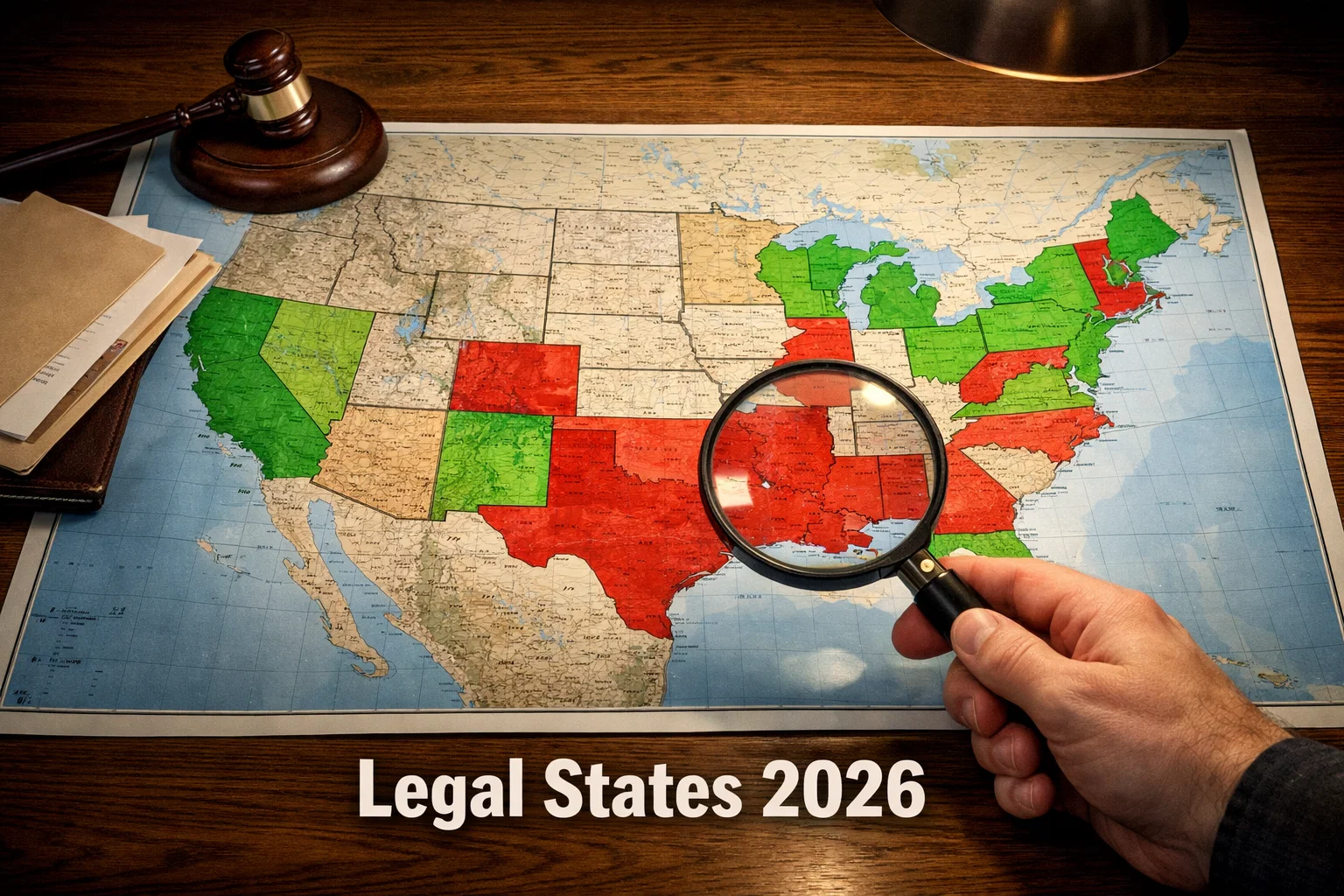
The current state-by-state landscape falls into three broad categories: states with explicit bans, states with restrictions or pending legislation, and states where sweepstakes casinos operate without specific prohibition. The boundaries between these categories are not always clean — some states have issued enforcement actions without passing formal bans, while others have passed bills that don’t take effect for months.
Banned states. As of early 2026, the list of states that have explicitly banned or effectively prohibited sweepstakes casino operations includes Washington, Idaho, Montana, Nevada, Michigan, and — most significantly — California and New York, both of which enacted bans during the 2025 legislative cycle. Washington was the earliest mover, with laws broad enough to capture the dual-currency model before most other states had even heard of it. Idaho and Nevada followed based on their own gambling statutes and existing regulatory frameworks. The California and New York bans represented a qualitative shift: these are the two largest state markets in the country, and their exits removed a combined player base that represented a significant share of national sweepstakes revenue. California alone accounted for approximately 17.3% of all US sweepstakes sales in 2025, according to EKG Gaming data cited by RG.org.
Restricted or pending. Several states have introduced bills targeting sweepstakes casinos without yet enacting full bans. New Jersey’s A5447 prohibits most dual-currency sweepstakes casinos while carving out narrow exceptions for promotional offers involving free entry or purchases under $20 without redeemable coins. Other states — including Ohio, Pennsylvania, and Connecticut — have active legislative proposals at various stages. These pending bills create uncertainty: operators may preemptively withdraw from a state where legislation is advancing, even before a ban takes effect, to avoid compliance costs or enforcement risk.
Available states. Sweepstakes casinos continue to operate in the majority of US states, including Texas, Florida, Illinois, Georgia, and most of the South and Midwest. The AGA’s 2025 consumer research found that the number of monthly sweepstakes casino players is roughly twice as high in states without bans compared to states that have enacted them — a finding that reflects both larger available populations and the effectiveness of bans in reducing participation. Availability in these states doesn’t mean permanent safety, though. The 2025 crackdown demonstrated that legislatures can move quickly when political will aligns, and several currently available states have seen preliminary discussions about sweepstakes regulation.
The practical implication for daily bonus players is straightforward: check your state’s current status before establishing a claiming routine, and stay alert for legislative changes. An operator’s “available states” page is a starting point, but not a guarantee — operators sometimes lag behind legislative changes in updating their geo-restrictions, and players who continue claiming in a newly banned state could face account complications during redemption.
It’s also worth noting that the banned-vs-available binary oversimplifies the landscape in some states. A few jurisdictions have enacted restrictions that don’t amount to full bans but limit specific features. Some states have required operators to disable certain promotional mechanics or purchase pathways while allowing the core sweepstakes model to continue. Others have imposed registration requirements that add friction without prohibiting access outright. These nuanced restrictions don’t always make headlines, but they can affect the specific daily bonus offerings available to you — a platform might operate in your state while disabling the streak bonus or limiting the daily wheel spin to GC-only prizes.
Bill Tracker: Legislation That Moved in 2025–2026
The 2025 legislative cycle was the most consequential year for sweepstakes casino regulation since the industry’s emergence. Multiple states introduced, advanced, and signed bills targeting the dual-currency model, and the pace of legislative activity accelerated as each new ban generated momentum for the next.
California AB 831. The most impactful single piece of legislation. AB 831 was signed by Governor Newsom on October 11, 2025, and took effect on January 1, 2026. The bill passed with unanimous support — 36-0 in the State Senate and 63-0 in the Assembly — making California the seventeenth state to take formal legal action against sweepstakes casinos. In a state legislature known for partisan division, the sweepstakes ban united both parties without a single dissenting vote. The bill bans the operation, advertising, and facilitation of sweepstakes casino platforms within California. What makes AB 831 particularly notable is its vendor liability provision, which extends criminal penalties to payment processors, geolocation providers, content suppliers, and media affiliates that facilitate sweepstakes casino operations targeting California residents.
New York SB 5935. Signed by Governor Hochul on December 5, 2025, with immediate effect. New York’s approach was notably aggressive: the bill imposes fines ranging from $10,000 to $100,000 per violation and includes the loss of any existing gaming licenses held by the violating entity. The New York market was estimated at $762 million in sweepstakes sales during 2024, making its loss a material financial hit for operators with significant East Coast player bases.
Montana SB 555. Signed by Governor Gianforte, effective October 1, 2025. Montana’s bill carries the harshest criminal penalties of any state ban to date: fines up to $50,000 and prison sentences of up to ten years, according to analysis by Snell & Wilmer LLP. While Montana’s player base is small relative to California or New York, the severity of its penalties sends a signal to operators about the potential consequences of continued operation in hostile jurisdictions.
As Shawn Fluharty, President of the National Council of Legislators from Gaming States and West Virginia Delegate, put it at the NCLGS Winter Conference in December 2025: “Rarely do we agree on anything as lawmakers, but on this issue, we agree that this represents illegal gambling operations.” That bipartisan consensus — visible in California’s unanimous vote and echoed in legislative discussions across multiple states — suggests the regulatory trend is more likely to expand than reverse in the near term.
Additional bills at various stages include proposals in Ohio, Pennsylvania, Connecticut, and several southern states. Not all will pass, and some may stall in committee. But the trajectory is clear: the 2025 wave was not an anomaly. It was the beginning of a sustained legislative response to an industry that grew faster than the regulatory framework could accommodate.
Penalties and Enforcement: What Operators Face
Legislative bans create the legal framework. Enforcement is what gives them teeth. The 2025 crackdown wasn’t limited to new legislation — it also brought a significant escalation in direct enforcement actions against operators already operating in states with existing prohibitions or ambiguous legal status.
Over the course of 2025, more than 100 cease-and-desist letters were sent to sweepstakes operators by state attorneys general and gaming commissions in Arizona, Michigan, Louisiana, Maryland, Mississippi, and other states, according to reporting by iGaming Business. These weren’t form letters — many were accompanied by specific deadlines for platform withdrawal, and several led to operators voluntarily exiting states rather than risk further legal exposure.
The penalty structures vary dramatically across jurisdictions. Montana’s SB 555 sits at the extreme end with its $50,000 fines and ten-year prison sentences. New York’s SB 5935 imposes $10,000 to $100,000 per violation plus potential loss of gaming licenses. California’s AB 831 adds the vendor liability layer: payment processors, geolocation providers, game content suppliers, and affiliate marketers face fines of $1,000 to $25,000 per violation and potential prison sentences of up to one year for facilitating sweepstakes operations in the state, per analysis by ZwillGen.
This vendor liability concept is potentially the most disruptive enforcement mechanism to emerge from the 2025 crackdown. Most sweepstakes casinos rely on a shared ecosystem of third-party services — payment processors like Skrill and ACH providers, geolocation vendors, game aggregators, and advertising networks. If these vendors face criminal liability for serving sweepstakes operators in banned states, the economic calculation shifts. A payment processor earning modest fees from sweepstakes clients may decide the risk isn’t worth the revenue, particularly if California’s vendor liability model is replicated by other states.
Enforcement also extends beyond formal penalties. Several state gaming commissions have increased monitoring of sweepstakes advertising, flagging operators who continue running ads targeting residents of banned states after ban effective dates. The advertising angle matters for daily bonus players because promotional notifications — the push alerts and social media posts that remind you to claim your bonus — can become compliance violations for operators if delivered to players in restricted states.
Self-Regulation: SPGA, SGLA, and the Code of Conduct
While state legislatures were drafting bans, the sweepstakes industry was attempting to build its own regulatory infrastructure — a bet that self-regulation could outpace government action and demonstrate that the industry could police itself. The timeline of this effort is compact and revealing.
In September 2024, a group of operators formed the Social and Promotional Gaming Association (SPGA), the industry’s first attempt at a unified self-regulatory body. By December 2024, the SPGA had published its Code of Conduct, establishing standards for age verification, KYC and geolocation protocols, anti-money laundering measures, and responsible gaming commitments. The code was voluntary — member operators could adopt it, but there was no enforcement mechanism for non-compliance beyond potential expulsion from the association.
Separately, VGW — the largest operator in the space — launched the Social Gaming Leadership Alliance (SGLA) in May 2025, led by former US Congressman Jeff Duncan as Executive Director. The SGLA positioned itself as an advocacy and standards organization, with a particular focus on engaging state legislatures and making the case for regulation rather than prohibition. In September 2025, the SPGA merged into the SGLA, creating a single industry body representing a significant portion of the operational sweepstakes casino market.
The Code of Conduct itself covers reasonable ground: mandatory age verification at registration, KYC documentation before first redemption, geolocation compliance with state restrictions, spending limits and cooling-off mechanisms, and commitments to responsible gaming messaging. Whether these standards are enforced consistently across member operators is a different question — and one that critics, including the AGA, have raised repeatedly. The Code is a declaration of intent, not a regulatory framework with independent auditing or penalty authority.
For daily bonus players, the SGLA’s existence and the Code of Conduct provide a partial trust signal. A platform that’s an SGLA member has at least committed publicly to a set of standards around verification, responsible gaming, and operational transparency. That commitment doesn’t guarantee compliance, and it doesn’t substitute for state-level regulation, but it does distinguish member operators from the dozens of platforms operating with no self-regulatory affiliation at all. When evaluating a new casino’s daily bonus, checking SGLA membership status is one data point worth noting.
What Changes Mean for Your Daily Bonus
The legal reshuffling of 2025–2026 has concrete implications for anyone building a daily bonus routine. These aren’t abstract regulatory developments — they affect which platforms you can access, which bonuses remain available, and how you should think about long-term SC accumulation strategies.
The most immediate impact is platform availability. If you’re in California, New York, Montana, or any other state that enacted a ban during 2025, the sweepstakes casinos you were logging into last year have either geo-blocked your state or are in the process of doing so. Attempting to circumvent geo-restrictions through VPN usage is both a terms-of-service violation on every major platform and a potential legal risk in states with active enforcement provisions. The practical response is binary: if your state has banned sweepstakes casinos, your daily bonus routine at those platforms is over.
For players in states where sweepstakes casinos remain available, the crackdown has an indirect benefit. Operators losing access to major markets like California and New York face revenue pressure, and one response to that pressure is intensifying competition for remaining players. Several platforms adjusted their daily bonus structures upward in states they could still serve, using more generous SC payouts and enhanced streak mechanics to compensate for lost market access elsewhere. If you’re in a state where sweepstakes casinos are legal, 2026 may be the best year yet for daily bonus value — the competition for your login has never been fiercer.
The uncertainty factor is harder to quantify but equally important. Players in states with pending legislation — Ohio, Pennsylvania, Connecticut, and others — face the possibility that their access could be restricted mid-streak. Building a daily bonus strategy around a platform that might exit your state in six months introduces risk to any long-term accumulation plan. The mitigating approach is diversification: spread your daily bonus routine across multiple platforms so that losing access to one doesn’t wipe out your entire SC pipeline. And keep a realistic timeline for redemption — if legislation is advancing in your state, prioritize playing through and redeeming your existing SC balance rather than accumulating more.
Know your state before you claim. That principle was always good practice. In 2026, it’s essential.
The wider context is set out in our daily bonus comparison.