
KYC Is the Gate Between Your SC Balance and Your Bank Account
You can accumulate Sweeps Coins for months through daily bonuses, social media giveaways, and AMOE mail-in requests. But none of that SC reaches your bank account until you pass KYC — Know Your Customer verification. It’s the process by which sweepstakes casinos confirm that you are who you say you are, that you’re of legal age, and that you reside in a state where the platform operates legally.
KYC isn’t optional. Every legitimate sweepstakes casino requires it before processing your first SC redemption. The industry’s move toward self-regulation has formalized these standards: the SPGA (Social and Promotional Gaming Association), which merged with the SGLA in September 2025, established a Code of Conduct in December 2024 that includes age verification, KYC procedures, and geolocation requirements as baseline operator obligations, as reported by Deadspin.
For daily bonus players who’ve spent weeks building an SC balance, the KYC process is the final hurdle before a cashout. Getting it right the first time saves days or weeks of delays. Getting it wrong — submitting blurry documents, mismatched names, or incomplete information — can stall your redemption indefinitely.
It stands between you and a cashout.
Required Documents by Platform
KYC requirements are broadly similar across sweepstakes casinos, but the specifics vary enough that using a one-size-fits-all approach will trip you up.
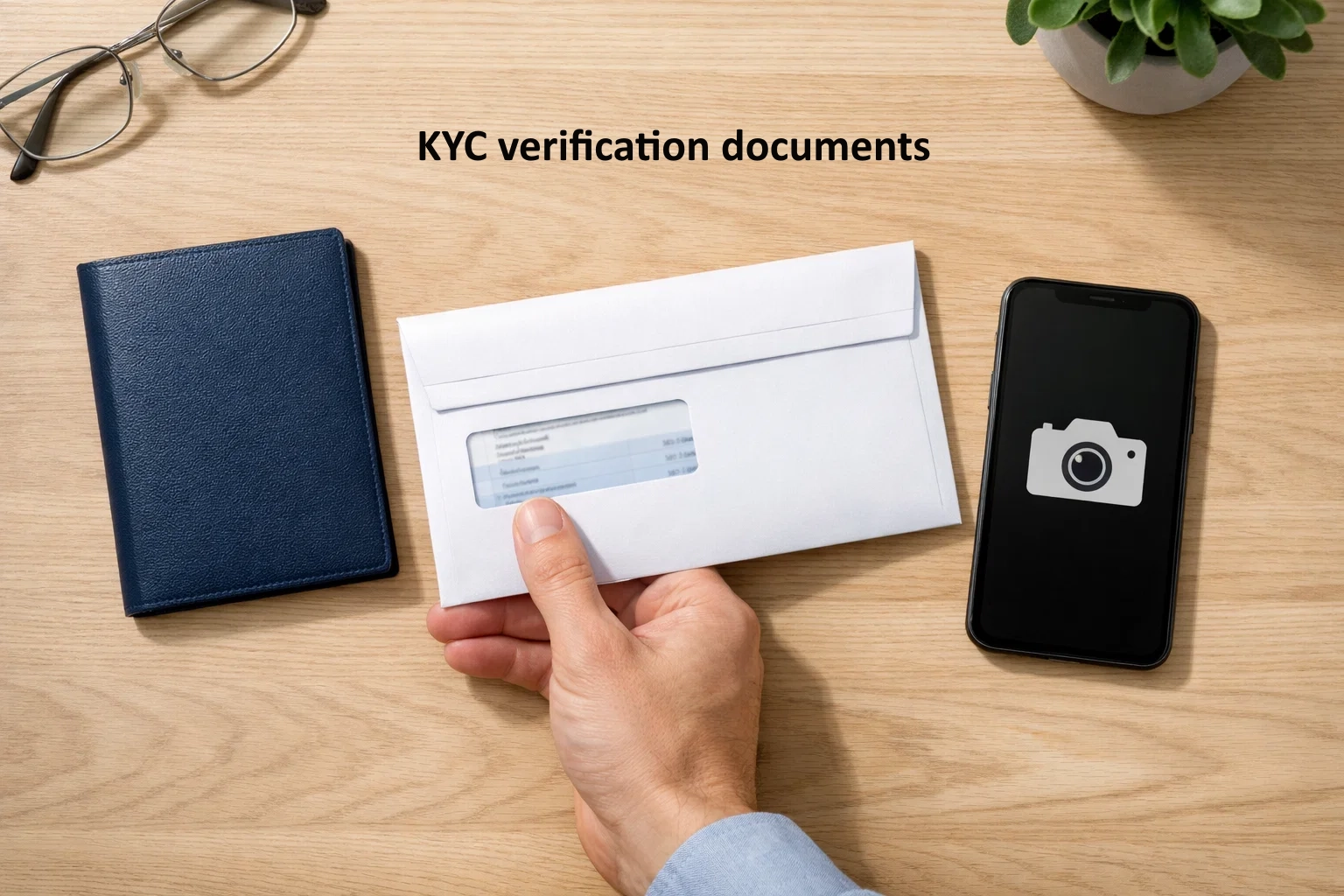
The universal requirement is government-issued photo ID. Every platform accepts a US driver’s license or state ID card. Most also accept US passports. The document must be valid (not expired), clearly photographed or scanned, and show your full legal name, date of birth, and photo. All four corners of the document should be visible in the image — cropped photos that cut off edges are a common rejection trigger.
Proof of address is required by most platforms but not all. Acceptable documents typically include a utility bill, bank statement, or government correspondence dated within the last 90 days. The name and address on this document must match the name and address on your casino account exactly. Even minor discrepancies — “Robert” on the bill versus “Bob” on the account, or a missing apartment number — can trigger a rejection.
Some platforms request a selfie alongside your ID — a photo of you holding your ID card next to your face. This is becoming more common as operators tighten their anti-fraud measures. The selfie must clearly show both your face and the ID, with enough lighting and resolution for the details to be readable.
The volume of KYC submissions across the industry is substantial. AGA research found that 80% of sweepstakes casino players spend money monthly, and nearly half spend weekly. That level of transaction activity translates to a high volume of first-time redemption requests flowing through KYC pipelines, which partly explains the processing times discussed below.
A few platforms have introduced automated KYC using identity verification APIs that can confirm your identity in minutes by cross-referencing your submitted documents against public records databases. Chumba Casino and WOW Vegas have implemented forms of automated verification, though the process still requires human review in some cases — particularly when automated checks flag a discrepancy.
Typical Verification Timelines
Verification timelines range from under an hour at the fastest platforms to over two weeks at the slowest — and the difference matters when you’re waiting to cash out SC you’ve been accumulating for months.
At the fast end, platforms with automated KYC can verify straightforward submissions within one to four hours during business hours. Chumba Casino and WOW Vegas typically fall in this range for clean submissions — valid ID, matching address proof, clear photos. If everything checks out on the automated pass, you receive a confirmation and can proceed to redemption.
Mid-range timelines of 24 to 72 hours are common at platforms that use a combination of automated and manual review. Your submission enters a queue, gets an initial automated screen, and is then reviewed by a human agent who confirms the documents. McLuck, High 5 Casino, and Pulsz generally operate in this window, though volume spikes (promotional periods, new game launches that drive a wave of new redemptions) can push timelines toward the longer end.
The slow end — 5 to 14 business days — is associated with smaller operators, platforms experiencing rapid growth that outpaces their compliance infrastructure, and cases where your submission triggers a manual review flag. Stake.us has historically had slower verification times compared to the market leaders, and newer platforms without established KYC pipelines can take even longer.
One critical nuance: the verification timeline is separate from the redemption timeline. Passing KYC means you’re approved to redeem. The actual transfer of funds — via Skrill, bank transfer, or other methods — has its own processing period on top of the KYC wait. Plan for the total time from submission to cash in your account, not just the KYC portion.
Common Rejection Reasons and Fixes
KYC rejections are frustrating but usually fixable. Understanding the most common causes lets you avoid them on the first attempt — or resolve them quickly if they occur.
Blurry or cropped document photos are the most frequent rejection trigger. Use good lighting, hold your phone steady, and ensure all four corners and all text on the document are clearly visible. Take the photo on a flat, contrasting surface (dark ID on a light background) rather than holding it in your hand, which introduces shake and shadows.
Name mismatches between your casino account and your verification documents are the second most common issue. If you registered with a nickname, abbreviation, or different name variant than what appears on your government ID, you’ll need to contact customer support to update your account information before resubmitting. Some platforms allow account name changes; others require you to re-register, which means losing any accumulated SC on the original account.
Expired documents get rejected automatically at most platforms. Check the expiration date on your ID before submitting. If your license is within a month of expiring, consider renewing it first to avoid the possibility of it expiring during a lengthy review process.
Address proof that’s too old (beyond 90 days) or that doesn’t match your registered address will be rejected. If you’ve recently moved, update your casino account address before submitting KYC documents. Ensure the address format matches — “Apt 4B” versus “#4B” versus “Unit 4B” can sometimes cause issues with automated matching systems.
If your KYC is rejected, the platform should provide a reason (though the level of detail varies). Address the specific issue, resubmit clean documents, and allow the standard processing time again. Multiple rejections at the same platform may trigger enhanced scrutiny, so getting it right on the second attempt matters.
A less common but particularly frustrating rejection occurs when the platform’s geolocation check places you in a restricted state, even though you physically reside in an allowed state. This can happen if you use a VPN (which most platforms prohibit), if your ISP routes through servers in another state, or if your mobile device’s location services are inaccurate. If you receive a location-based rejection while physically in an eligible state, contact customer support with proof of your address — the same utility bill or bank statement you submitted for address verification usually resolves it.
For daily bonus players specifically, one practical recommendation: complete KYC before you need it. Many platforms allow you to submit verification documents proactively, even before you’ve accumulated enough SC to redeem. Doing this early — during your first week on the platform — means the verification is already approved when you eventually reach the redemption threshold. You avoid the frustration of waiting days for KYC approval while a meaningful SC balance sits locked in your account. The KYC verification process is a one-time gate — pass it once, and subsequent redemptions flow through without repeating the full verification.
The wider context is set out in our daily bonus comparison.
This content is for informational purposes only. Sweepstakes casino availability varies by state. Always verify that a platform operates legally in your jurisdiction before registering. Play responsibly.